Is Your Phone Stealing More Than Your Time?
How excessive mobile phone use, sleep and mood may be connected
You tell yourself you will check your phone for five minutes before going to bed.
One reel becomes three. One message becomes a conversation. One video becomes another.
You finally put the phone down, look at the clock and realise that those five minutes became forty.
The next morning, you are tired, irritable and struggling to concentrate.
For many of us, this has become such a familiar routine that we barely notice it anymore.
But could excessive phone use be affecting more than just the amount of time we spend looking at a screen?
Our recent research suggests that sleep may be an important part of the answer.
What did we study?
We wanted to understand the relationship between three things: mobile phone use, sleep, and depressive symptoms.
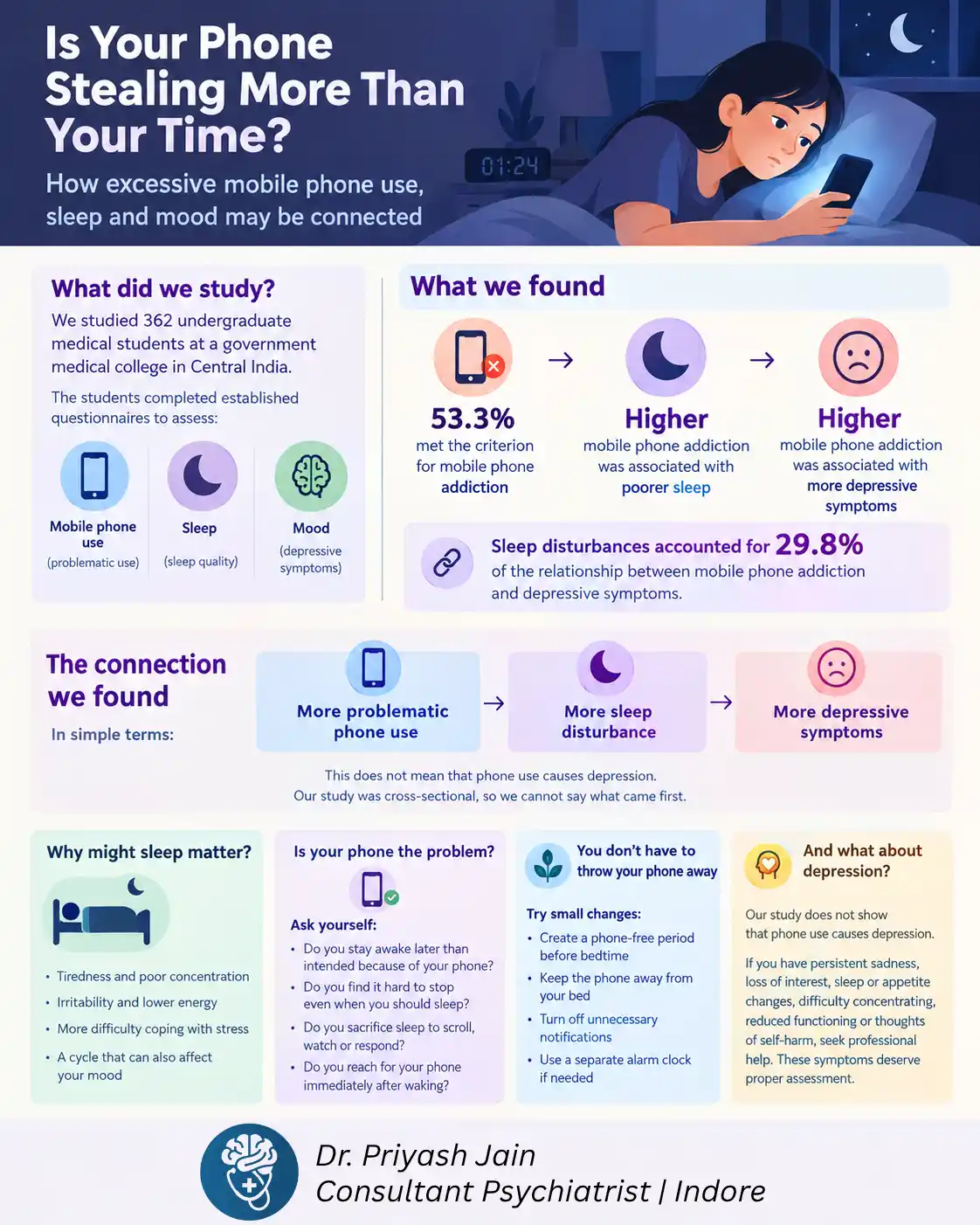
We studied 362 undergraduate medical students at a government medical college in Central India. The students completed established questionnaires assessing problematic mobile phone use, sleep quality and depressive symptoms.
The results were interesting.
53.3% met the criterion for addiction
Just over half the students scored positive for mobile phone addiction on the scale used in the study.
Poorer sleep, higher depression scores
Higher levels of mobile phone addiction were associated with poorer sleep and higher depressive symptom scores.
Sleep explained 29.8% of the link
In our statistical analysis, sleep disturbances accounted for 29.8% of the relationship between mobile phone addiction and depressive symptoms.
In simple terms:
This does not mean that every person who uses a phone extensively will develop depression.
It also does not mean that phone use has been proven to cause depression.
Our study was cross-sectional, meaning that we looked at these factors at one point in time. Therefore, we cannot determine exactly what came first or prove a cause-and-effect relationship.
What the study does show is that these three things are closely connected, and that sleep may be one of the pathways linking problematic phone use with depressive symptoms.
Why might sleep matter so much?
Think about what happens when your phone follows you into bed.
You may intend to sleep at 11 p.m., but continue scrolling until midnight.
You may wake up during the night and check a notification.
You may start the morning by reaching for your phone before you have even got out of bed.
The problem is not simply the screen itself. It is the way excessive phone use can begin to interfere with our sleep routine.
And sleep is not merely the period when we are doing nothing.
While we sleep, the brain is carrying out important processes involved in memory, emotional regulation and restoration. When sleep becomes inadequate or disturbed, we may notice the consequences during the day: tiredness, reduced concentration, irritability, lower energy and difficulty coping with everyday stress.
Sleep and mood also influence one another.
A person who is feeling low may sleep poorly. Someone who repeatedly sleeps poorly may find their mood, energy and ability to cope becoming worse.
This means that the relationship between sleep and mental health is rarely a simple one-way road.
So, is your phone the problem?
Not necessarily.
Phones are extraordinarily useful. We use them to communicate, study, work, navigate, read, exercise, entertain ourselves and stay connected to people.
The important question is not: "How many hours do you use your phone?"
A better question may be: "Is my phone use beginning to interfere with things that matter to my health?"
For example:
Staying up past your intention
Do you regularly stay awake later than intended because you are using your phone?
Difficulty stopping
Do you find it difficult to stop using it even when you know you should sleep?
Sacrificing sleep to scroll
Do you frequently sacrifice sleep to scroll, watch videos or respond to messages?
Reaching for it first thing
Do you reach for your phone immediately after waking, despite having slept poorly?
If these patterns are becoming routine, the issue may not simply be screen time. It may be that your phone has begun to take control of your bedtime.
You don't have to throw your phone away
The answer does not have to be deleting every social media app or turning your phone into a brick.
Start smaller.
Set a wind-down window
Try creating a phone-free period before bedtime.
Move it away from the bed
Put the phone away from the bed rather than next to your pillow.
Turn off notifications
Turn off unnecessary notifications that pull you back in.
Use a separate alarm clock
If you use your phone as an alarm, consider switching to a dedicated alarm clock.
The goal is not to fear your phone. It is to make sure that you remain in control of how you use it.
And what about depression?
This is where some caution is important.
Our findings do not mean that excessive phone use causes depression.
Depression is a complex condition involving biological, psychological and social factors. Mobile phone use is only one potential factor among many.
However, the finding that sleep disturbances accounted for part of the relationship between mobile phone addiction and depressive symptoms gives us something useful to think about.
Sleep may be a modifiable part of the picture. If excessive phone use is disrupting someone's sleep, addressing that sleep disruption may be one practical place to begin. But persistent sleep problems or changes in mood should not simply be blamed on the phone.
If you are experiencing persistent sadness or loss of interest, significant sleep or appetite changes, difficulty concentrating, a decline in day-to-day functioning, or thoughts of self-harm, it is worth talking to a mental health professional. These symptoms deserve proper assessment rather than being dismissed as simply "too much screen time."
Sometimes, the problem is bigger than the phone
Our phones are remarkably good at filling every quiet moment.
But when scrolling starts replacing sleep, when poor sleep starts affecting the day, or when low mood and anxiety begin interfering with everyday life, it may be time to look beyond the screen.
You don't need to wait until things become overwhelming before seeking help.
If you are in Indore and are struggling with sleep problems, persistent low mood, anxiety, excessive or difficult-to-control phone use, or other concerns affecting your mental well-being, a psychiatric consultation can help you understand what may be contributing to the problem and what can be done about it.
Your phone may be part of the story. It may not be the whole story.
Sometimes, understanding that difference is the first step towards feeling better.
References and Sources
- Jain P, Chaturvedi K, Bagul KR, Mudgal V. The mediating role of sleep disturbances in mobile phone addiction and depression among medical students. Journal of Family Medicine and Primary Care. 2025;14(6):2287-2293. https://doi.org/10.4103/jfmpc.jfmpc_1546_24
- Tompa R. How sleep affects mental health (and vice versa): What the science says. Stanford Medicine. https://med.stanford.edu/news/insights/2025/08/sleep-mental-health-connection-what-science-says.html
This article is for general educational purposes and is not a substitute for professional psychiatric advice, diagnosis or treatment. Please consult a qualified mental health professional for concerns specific to you.
Found this article helpful? Share it!
Need Expert Psychiatric Help?
Dr. Priyash Jain is here to help. Book a consultation today and take the first step towards better mental health.