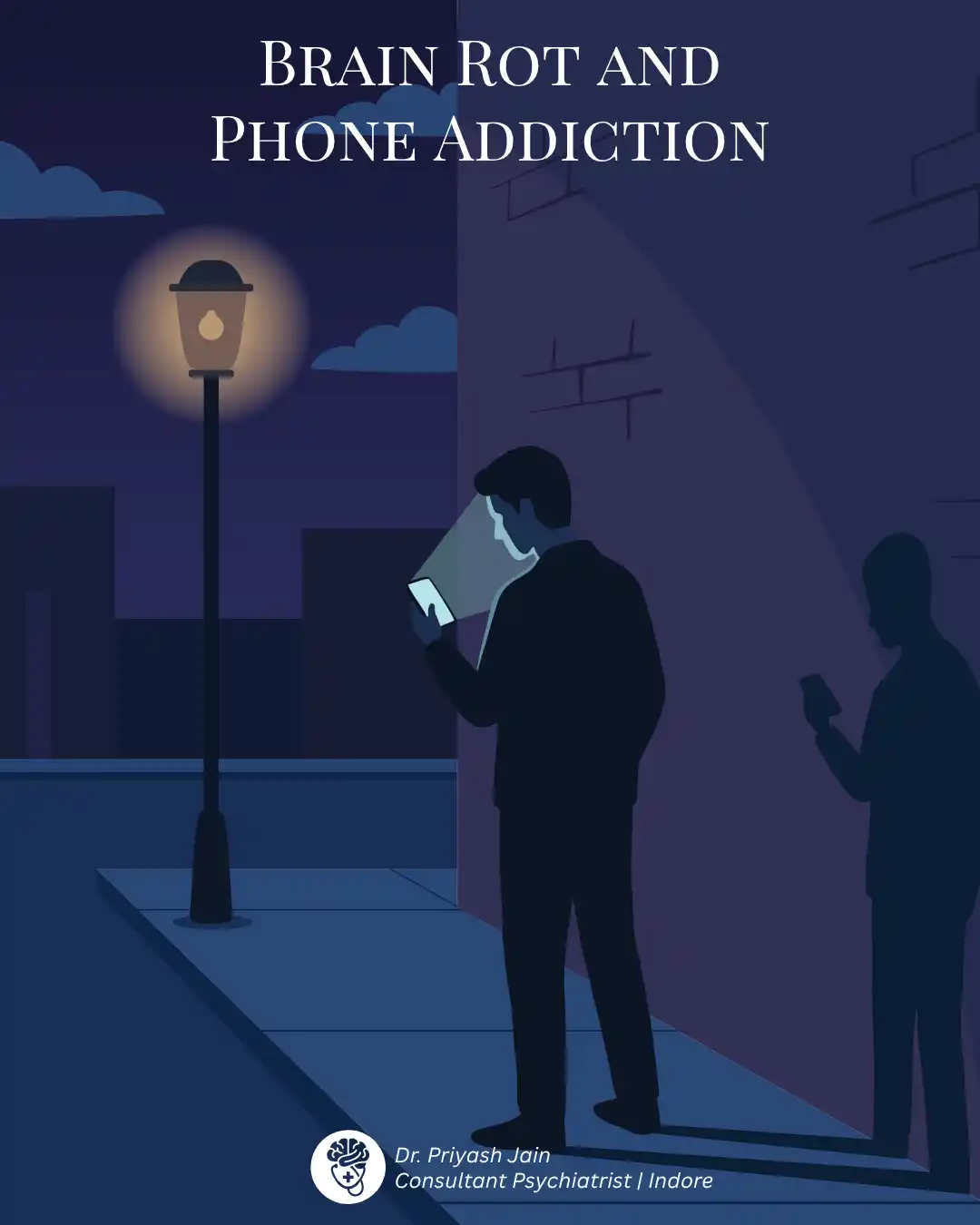
A patient tells me they have tried, more than once, to put their phone down for the evening and simply could not. Another says they no longer finish a book, or even a long article, without the urge to check something else. Between Oxford naming "brain rot" its 2024 Word of the Year and near daily headlines about phone addiction, this has become one of the more common concerns raised in consultation, not just by teenagers but by working adults and parents alike.
As a psychiatrist in Indore, I get asked a version of the same question often: is this actually an addiction, and does a digital detox help? Here is a short, evidence based answer.
Is It Really an "Addiction"?
Not officially, at least not yet, for most people. The DSM-5-TR recognizes only gambling disorder as a non-substance behavioral addiction. Smartphone and social media use are not formal diagnoses. The one exception is Gaming Disorder, which the WHO's ICD-11 formally classified in 2019. Researchers have since adapted those same criteria to build screening tools for problematic social media use, but it remains a research construct, not a diagnosis code.
That said, absence of a formal label does not mean absence of harm. "Brain rot" itself is not a clinical term. Oxford defines it as the perceived mental dulling from consuming excessive low value online content, but it captures something patients genuinely feel in day to day life: reduced attention span, restlessness without the phone, and a sense of time lost.
Signs Worth Paying Attention To
- Using the phone despite it clearly interfering with sleep, work, or relationships
- Reaching for it automatically, with little awareness of why
- Irritability or anxiety when separated from it
- Escalating time spent, with diminishing satisfaction
- Repeated but unsuccessful attempts to cut back
One or two of these occasionally is normal in modern life. A consistent pattern across most of them, especially with functional impact, is worth discussing with a mental health professional.
Does a "Digital Detox" Actually Work?
Clinical note: Reducing use tends to help more consistently than total abstinence. Complete digital fasting is not automatically superior, and some studies even found no well-being difference between use days and abstinence days, occasionally showing worse social connectedness on abstinence days. For most patients, a structured cutback works better than an all or nothing break, and is easier to sustain as a long term habit.
Five Practical Steps
Set App Limits
App level time limits, not just phone level ones. Built in screen time tools work better than willpower alone.
Protect Bedtime
Keep the bedroom phone free for the last 30 to 60 minutes before sleep. This improves both sleep quality and next day scrolling patterns.
Substitute, Do Not Subtract
Replacing scroll time with physical activity has a moderate to large effect on reducing problematic use, more reliably than simply trying to use the phone less.
Set Household Norms
Device free meals or shared put away hours reduce use more sustainably than one person trying alone.
Track Patterns
Note when and why you reach for the phone, such as boredom, anxiety, or habit. This is often more useful than the raw hours per day number.
When to Consult a Psychiatrist
If phone or social media use is consistently affecting sleep, mood, academic or work performance, or relationships, and self directed changes have not helped, it is worth seeking a proper psychiatric evaluation rather than relying on generic advice. This is especially true if it coexists with anxiety, depression, or attention difficulties, which is common and often treatable together. At our clinic in Old Palasia, Indore, assessment typically involves a detailed history, screening for coexisting conditions, and where appropriate, a structured treatment plan rather than an unsustainable cold turkey approach.
References and Sources
- Marciano L, Jindal S, Viswanath K. Digital Detox and Well-Being. Pediatrics. https://pmc.ncbi.nlm.nih.gov/articles/PMC11422191/
- Radtke T, Apel T, Schenkel K, Keller J, von Lindern E. Digital detox: An effective solution in the smartphone era? Mobile Media & Communication. https://journals.sagepub.com/doi/10.1177/20501579211028647
- Ansari S, Iqbal N, Azeem A, Danyal K. Improving Well-Being Through Digital Detoxification Among Social Media Users. Cyberpsychology, Behavior, and Social Networking. https://www.liebertpub.com/doi/abs/10.1089/cyber.2023.0742
- Pirwani N, Szabo A. Physical activity and smartphone addiction in university students. Preventive Medicine Reports. https://www.ncbi.nlm.nih.gov/pmc/articles/PMC12304691/
- World Health Organization. Gaming Disorder. ICD-11. https://www.ncbi.nlm.nih.gov/pmc/articles/PMC12640003/
- Paschke K, Austermann MI, Thomasius R. ICD-11-Based Assessment of Social Media Use Disorder in Adolescents. Frontiers in Psychiatry. https://pmc.ncbi.nlm.nih.gov/articles/PMC8100192/
- Oxford University Press. Oxford Word of the Year 2024: Brain Rot. Oxford Languages. https://corp.oup.com/word-of-the-year/
Disclaimer: This article is for educational purposes and should not replace professional medical advice. If you are concerned about your own or a family member's technology use, please consult a qualified mental health professional.
Found this article helpful? Share it!
Need Expert Psychiatric Help?
Dr. Priyash Jain is here to help. Book a consultation today and take the first step towards better mental health.