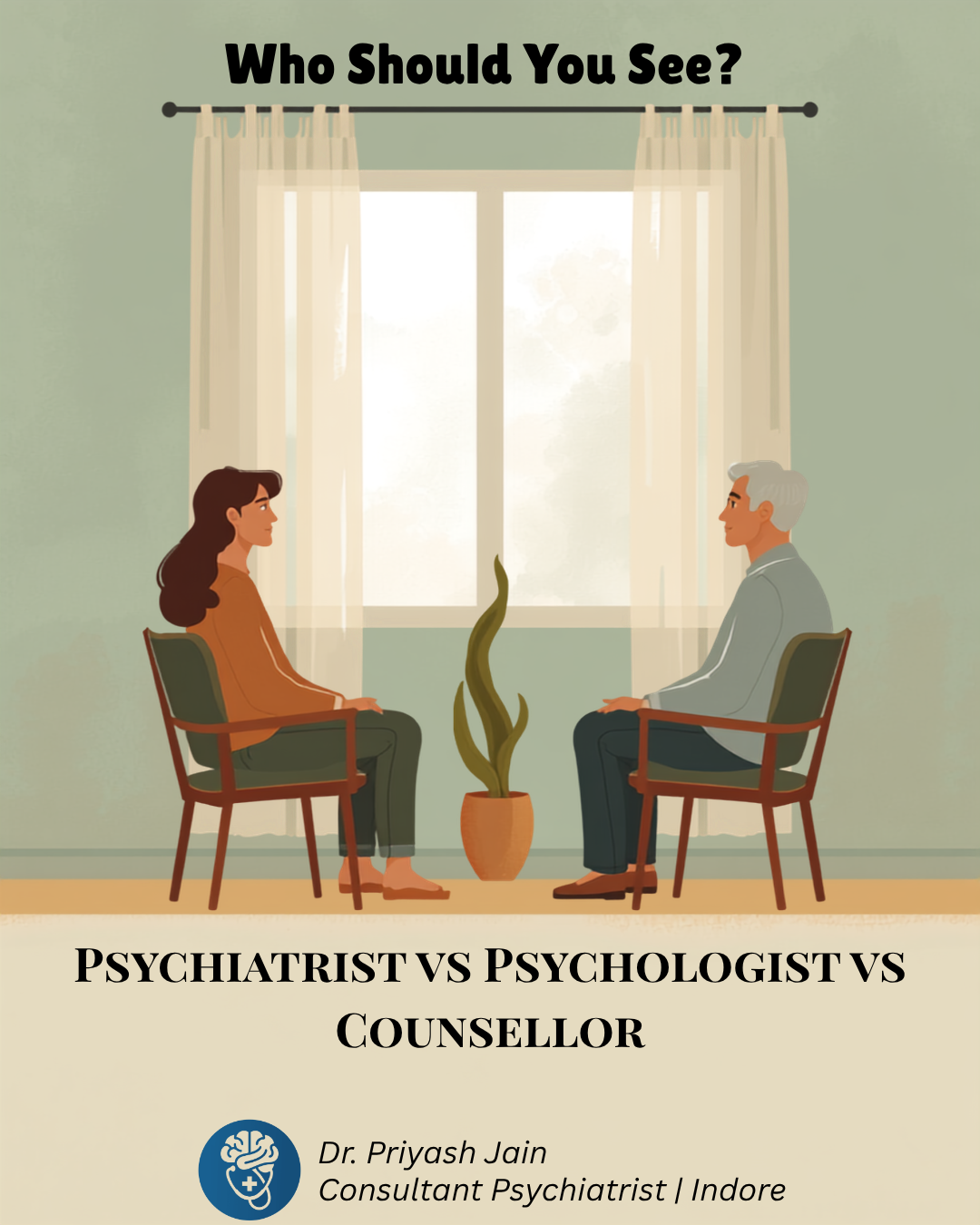
A patient once told me she had booked three appointments in two months, one with a "counsellor," one with a "psychologist," and one with a "therapist," before someone finally referred her to a psychiatrist for what turned out to be a straightforward case of moderate depression needing medication. She was not being careless. The terms genuinely overlap in everyday use, and in India, unlike some countries, only some of these titles are formally regulated. Knowing the difference can save you time, money, and unnecessary distress.
Psychiatrist: a medical doctor for the mind
A psychiatrist completes an MBBS degree followed by a postgraduate specialisation in psychiatry, typically MD Psychiatry, DNB Psychiatry, or DPM, and is registered with the National Medical Commission. This medical training is what allows a psychiatrist to diagnose mental illness, order relevant investigations, and prescribe medication such as antidepressants, mood stabilisers, or antipsychotics. Psychiatrists are also trained to recognise when a psychological symptom, like sudden confusion or mood change, actually has a physical cause such as a thyroid problem or a vitamin deficiency, something that requires a medical degree to evaluate safely.
Key Fact: Medication is not the only tool a psychiatrist uses. Many psychiatrists are also trained to provide psychotherapy, and some run combined sessions where medication and talk therapy are managed together in a single treatment plan.
Psychologist: assessment and structured therapy
A clinical psychologist holds a postgraduate degree in psychology along with an MPhil in Clinical Psychology, a qualification regulated by the Rehabilitation Council of India (RCI). This training equips them to conduct formal psychological assessments and deliver structured, evidence-based psychotherapy such as CBT or DBT. A clinical psychologist cannot prescribe medication. Many practitioners in India also offer therapy with a general MA or MSc in psychology, without the MPhil Clinical qualification, which is common and often genuinely helpful, though it is worth asking about training when formal diagnosis or specific therapy protocols are needed.
Counsellor: guidance through life's difficulties
A counsellor typically holds a postgraduate qualification in psychology or counselling and supports people through everyday emotional difficulties, relationship issues, grief, or stress. Importantly, "counsellor" is not a protected or separately regulated title in India, so training varies widely, from short certificate courses to full postgraduate diplomas. A counsellor does not diagnose mental health conditions or prescribe medication, but can be an excellent first point of contact for support that does not require clinical intervention.
Psychiatrist
- MBBS + MD/DNB Psychiatry
- Registered with NMC
- Can prescribe medication
- Can also provide therapy
- Diagnoses and treats mental illness
Psychologist
- MPhil Clinical Psychology (RCI-registered)
- Conducts formal assessments
- Delivers structured psychotherapy
- Cannot prescribe medication
Counsellor
- Certificate to postgraduate diploma
- Title not formally regulated
- Provides talking support
- Does not diagnose or prescribe
When should you consult each professional?
If symptoms are severe, sudden, or affecting your ability to function, if you suspect a condition that may need medication, or if you have thoughts of self-harm, start with a psychiatrist. If you mainly need to talk through a difficulty, understand your patterns of thought, or want a structured programme like CBT, a psychologist is often the right starting point. If you are dealing with a life stressor, relationship difficulty, or grief without a suspected clinical condition, a counsellor can be genuinely helpful.
Pro Tip: Before booking, simply ask about the professional's qualification and the institution it is from. A reputable practitioner will answer this readily, and hesitation about credentials is a reason to look elsewhere.
There is no wrong door. Mental health professionals routinely refer patients to one another, and many people are best served by a psychiatrist and a psychologist working together, medication and therapy in tandem, rather than choosing just one.
A simple rule of thumb
If you need medication, you need a psychiatrist. If you need to talk through what you are feeling, a psychologist or counsellor can help. If you are unsure, a psychiatric consultation is a safe starting point, since a psychiatrist can assess your situation and refer you onward to a psychologist or counsellor if that is what best suits your needs.
Remember: A psychiatrist can also provide therapy directly, so a psychiatric consultation does not automatically mean medication only. Treatment is tailored to what you actually need.
Frequently Asked Questions
Can a psychologist prescribe medicine in India?
No. Only a psychiatrist, registered with the National Medical Commission, can legally prescribe psychiatric medication.
Is a counsellor the same as a psychologist?
No. Counsellor is not a regulated title in India, while a clinical psychologist holds an RCI-registered MPhil qualification.
Should I start with a psychiatrist or a psychologist?
Start with a psychiatrist for severe or sudden symptoms or if medication may be needed. Otherwise, a psychologist or counsellor is a reasonable first step. Many people benefit from seeing both.
Can a psychiatrist provide therapy?
Yes. Many psychiatrists are trained to provide psychotherapy alongside medication, and some offer combined medication and therapy sessions themselves, or work closely with a psychologist so both are coordinated as one care plan.
This article is for educational purposes and is not a substitute for professional psychiatric or psychological advice. If you are experiencing mental health symptoms, please consult a qualified professional.
Found this article helpful? Share it!
Need Expert Psychiatric Help?
Dr. Priyash Jain is here to help. Book a consultation today and take the first step towards better mental health.